
‘Improving the energy efficiency of culturally valuable buildings means more than just technological solutions – it is an understanding of historical value and the innovative methods compatible with it, finding a balance between old and new. If we can keep houses in use wisely and with dignity, future generations will also be part of this history,’ said Ave Paulus, President of ICOMOS Estonia.
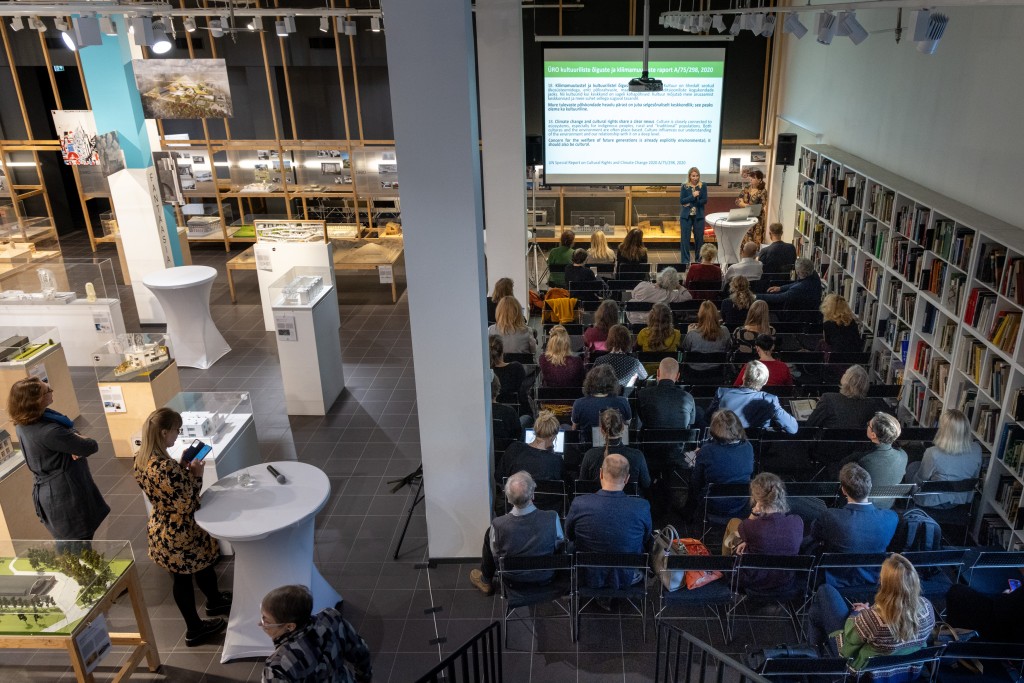
The conference was attended by speakers from Germany, Great Britain, Sweden, Norway, Finland, Latvia, Czech Republic, and Estonia. On the first day, 28 October, the focus in the Museum of Estonian Architecture was on European building heritage strategies in the green transition, giving examples from the Nordic and Baltic countries. The speakers included policy makers, scientists, architects, engineers and heritage guardians at both the international and local levels. Among others, Johanna Leissner, Chairman of the EU Open Method of Coordination Group, spoke about cultural heritage in the context of climate change; Andro Mänd, Chief Architect of Tallinn, spoke about the green transition in Tallinn; Arturs Lapins, President of the Latvian Association of Architects, spoke about sustainable restoration; and Marko Huttunen and Juulia Mikkola, representatives of ICOMOS Finland, spoke about natural ventilation solutions as part of the restoration of buildings.

Photo: Toomas Tuul
The conference continued with practical discussions on the second day, which focused on finding appropriate renovation solutions for historic buildings. Participants talked about shaping the attitudes of homeowners regarding the energy efficiency of houses of cultural significance, the definition of historical buildings in different countries, the impact of support programmes, and the Estonian perspective of heritage buildings that are not under cultural protection. Negative examples were also highlighted, where outright reconstruction of buildings has caused environmental damage, as well as direct damage to human health. It was stressed that in addition to improving the efficiency of buildings, it is important to pay attention to reasonable energy use, i.e. to look for ways to reduce energy consumption by changing simple means or habits – it is important to find sustainable solutions to reduce demolition and scrapping, and to encourage improvement and re-use.
The conference took place within the framework of the LIFE heritageHOME and BuildEST research development projects. The focus of the LIFE heritageHOME project, the ‘Roadmap for Renovation of Heritage Homes’, is to improve the energy efficiency of heritage-protected residential buildings in a way that preserves their cultural values. More information can be found on the website of the Ministry of Culture.
The event was organised by ICOMOS Estonia in cooperation with ICOMOS working groups, the Ministry of Culture, the Ministry of Climate, the National Heritage Board, TalTech, the Estonian Academy of Arts, the Museum of Estonian Architecture, and the Estonian Open Air Museum.
The video recording of the conference can be viewed on the ICOMOS Estonia website.


